

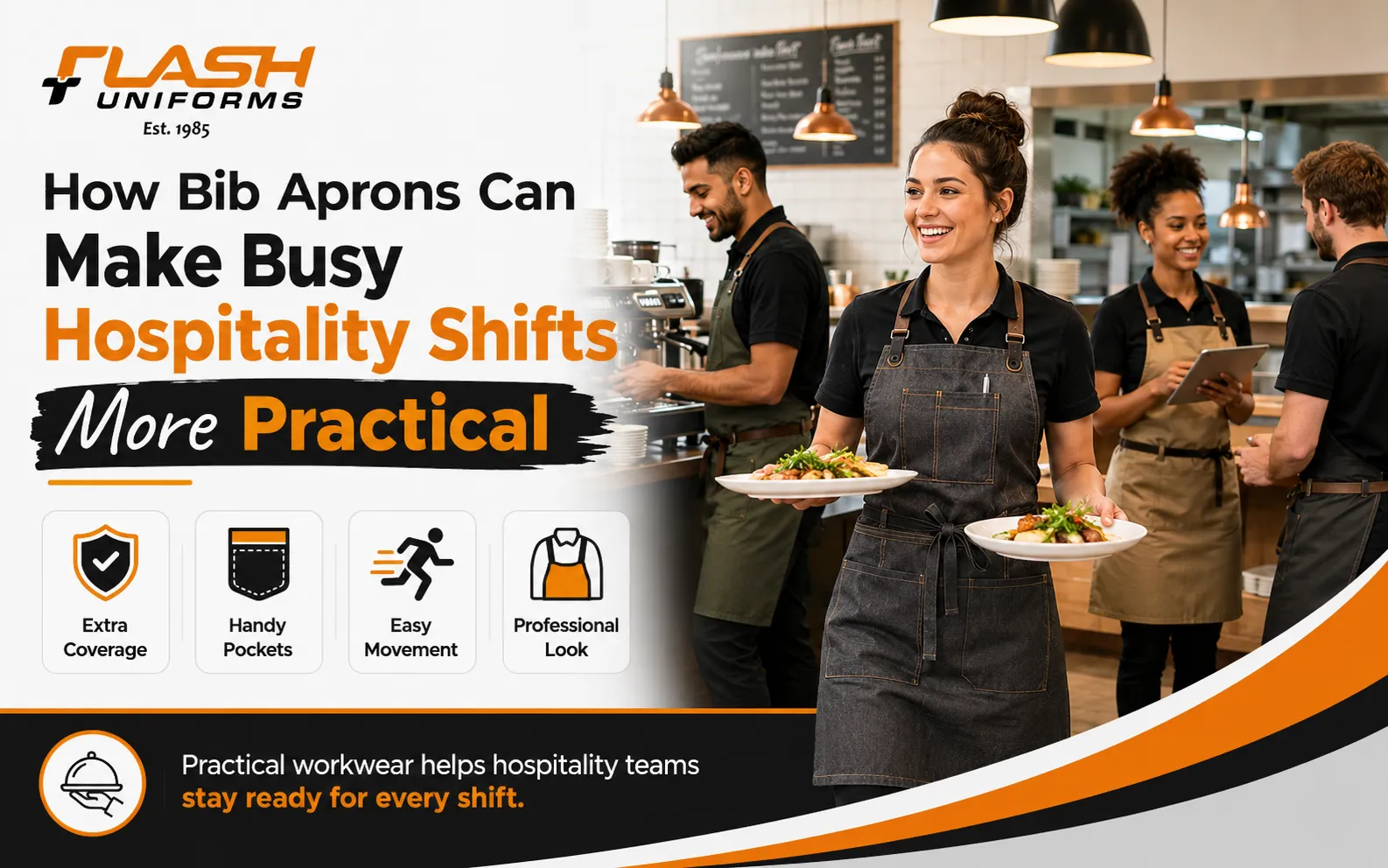
Hospitality work rarely involves standing still. During a busy service, staff move between tables, counters, kitchens, coffee machines, storage and customer-facing spaces within minutes — and their clothing has to keep up without becoming a distraction.
That’s part of why aprons remain a fixture in cafés, restaurants, bakeries, bars and catering businesses. A well-chosen apron does more than finish a look: it provides useful coverage, gives staff somewhere to keep small essentials, and helps a team look consistent. When businesses review their hospitality uniforms, it’s worth treating the apron as a practical part of the uniform rather than a decorative afterthought.
Why Practical Clothing Matters During Service
Hospitality staff switch between tasks constantly. A café worker might take an order, make a drink, clear a table and restock within a few minutes; restaurant staff move continually between customers and service areas; catering teams work in settings that change from one event to the next. Their clothing should make those movements easier, not harder.
In practice, that means an outfit staff can walk, turn and reach in without restriction, that carries the small essentials they use often, and that stays tidy through a shift across different working areas. An apron won’t solve every uniform challenge, but the right design makes a lot of everyday tasks more convenient.
What a Bib Apron Actually Is
A bib apron covers the front of the body, typically from the chest down towards the knees or upper legs, secured around the waist and supported by a neck strap or other upper-body fastening. That broader coverage is the main difference between a bib apron and a waist apron.
Waist aprons suit staff who mainly need pockets or lower-body coverage. Bib styles make more sense when a business wants extra protection across the front of shirts and other uniform garments. Neither is automatically better — because hospitality roles vary so much, the right choice depends on what staff actually do.
More Front Coverage Is Genuinely Useful
Spills and splashes are a normal part of many hospitality environments. Coffee, sauces, drink ingredients, food prep and clearing tables all expose clothing to everyday mess, and an apron puts another layer between those and the shirt underneath.
For staff working with food and drink throughout a shift, the extra chest coverage of bib aprons is particularly useful. It won’t keep the uniform underneath perfectly clean, but it reduces direct exposure during routine service — and an apron is far quicker to change than a whole uniform, which matters on long shifts where staff still need to look presentable in front of customers.
Pockets Make Repetitive Tasks Easier
One of the most useful apron features is also the simplest: a well-placed pocket. Hospitality staff regularly reach for pens, order pads, notepads, bottle openers, table numbers, cleaning cloths and small service accessories, and having them to hand means fewer trips back to a counter mid-service.
The best pocket arrangement depends on the role — waiting staff may value divided front pockets, while a barista might prefer a single central pocket for a cloth or tool. More pockets aren’t automatically better, though; large or badly placed ones become uncomfortable when overloaded. It’s usually better to design around what staff genuinely carry in a normal shift.
Adjustable Features Improve Comfort and Fit
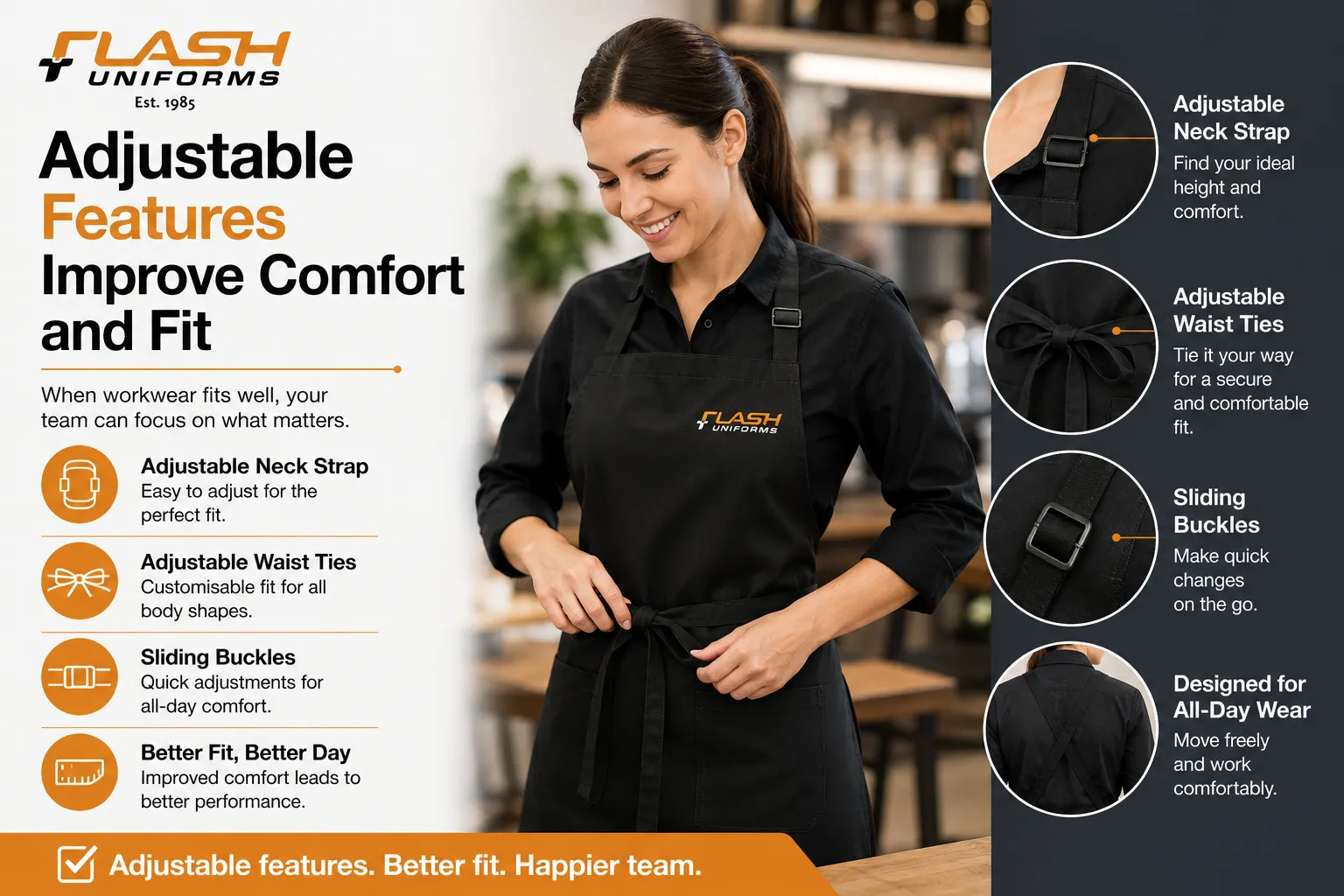
A hospitality team is rarely made up of people with identical builds, so if one apron design will be worn across a large team, adjustable straps and ties make it far easier for different staff to get a practical fit.
The neck strap matters most on a traditional bib apron — too low and it won’t provide the intended coverage, too tight and it becomes uncomfortable over a long shift. Waist ties should let the apron sit securely without restricting movement. Before ordering in quantity, it’s worth testing the apron on staff of different heights and builds, since something that looks right in a product image can fit quite differently in real use.
Match the Fabric to the Workplace
Appearance matters, but the material often has a bigger impact on how an apron performs day to day, and different settings have different needs. A casual café may want something lightweight and comfortable for constant movement; a busy restaurant may prioritise durability and frequent laundering; a venue with a distinctive identity may treat texture and appearance as part of the customer experience.
When comparing fabrics, weigh weight, breathability, ease of washing, drying requirements, durability, colour retention, feel against the body and suitability for regular use. No single fabric suits every hospitality business — the right one balances the working environment with the look you want and the laundry routine you can realistically manage.
Aprons Help Create a Consistent Team Look
A uniform says something about a business before anyone speaks, and customers quickly notice whether a team looks coordinated — which doesn’t require everyone in an identical outfit. An apron works well as a common element across different roles.
A café might pair the same apron with several approved shirt styles; a restaurant might use one colour for front-of-house and another for particular service roles. This creates consistency while letting the uniform accommodate different responsibilities, with colour, fabric and branding all contributing to the effect.
Keep Branding Restrained and Well-Placed
An apron gives a visible spot for branding — a chest logo is easily seen when staff serve customers, work behind a counter or move around an event. But effective branding doesn’t mean the biggest possible logo; a smaller, well-positioned one often looks cleaner and more professional.
When planning branded aprons, consider logo position and size, garment colour and contrast, the decoration method, and how the apron coordinates with shirts and other garments. The finished uniform should still look balanced — if the apron already has distinctive colours or trims, restrained branding usually works better than an oversized graphic.
Choose Colours for Real Conditions
A colour can suit a venue’s branding perfectly and still be impractical in service. Very light aprons show some stains more; darker ones give a different look but don’t suit every brand or setting. Think about where the apron is worn and what staff come into contact with — coffee shops, bakeries, restaurants, bars and catering teams all have different priorities.
It also helps to picture how a colour looks after repeated washing rather than judging it new. The aim is a colour that fits both the brand identity and the practical realities of the workplace.
One Apron Style Can Unite Different Roles
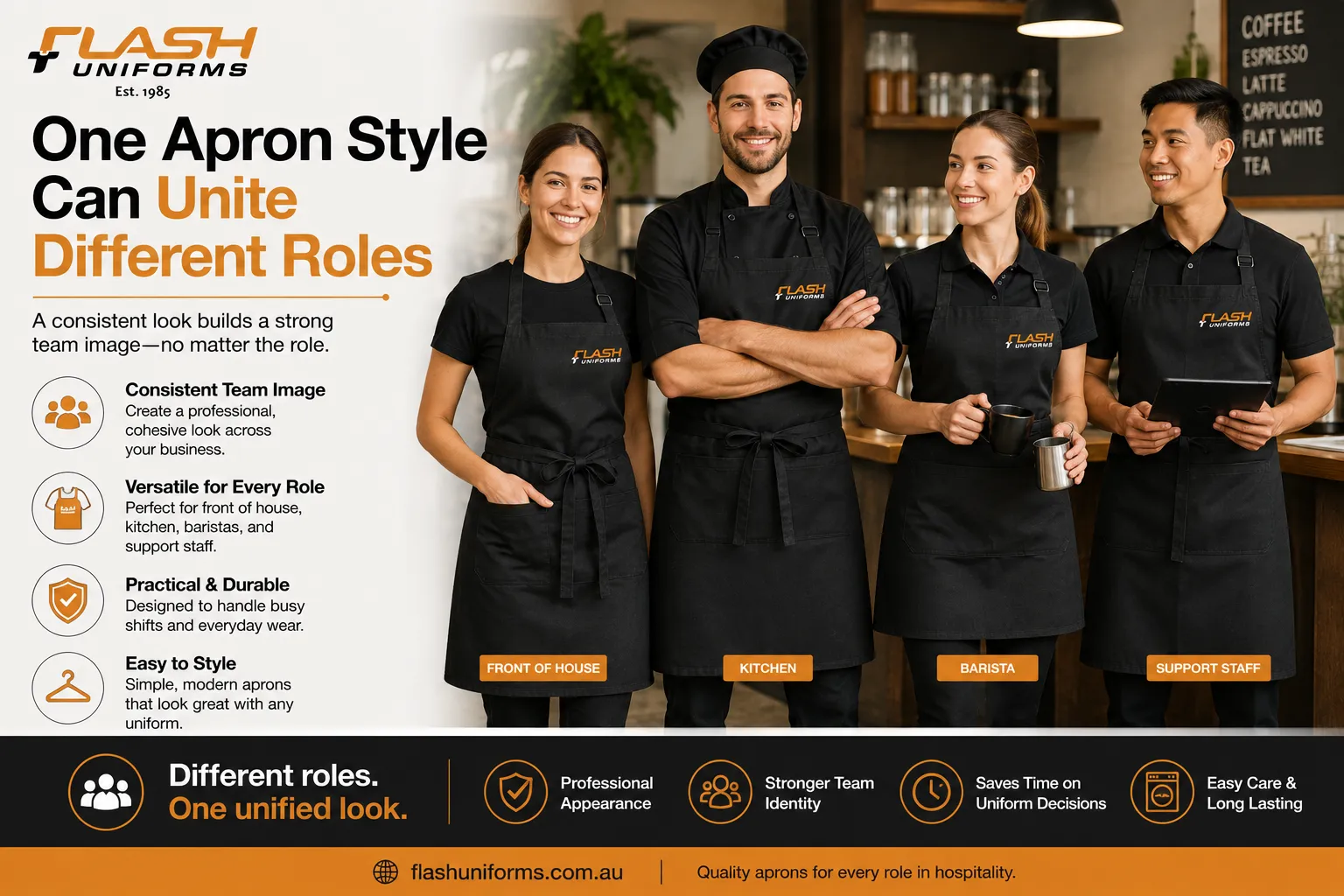
Hospitality venues often employ people with very different responsibilities — baristas, waiting and counter staff, bartenders, kitchen and food-prep staff, catering crews and supervisors. They don’t all need the same clothing, but a common apron style can visually connect them while the garments underneath vary.
One employee might wear a polo and another a button-up shirt, yet matching aprons still make the team look coordinated. That’s especially useful for a business wanting a consistent identity without forcing one garment combination onto everyone.
Plan for Cleaning and Replacement
Hospitality clothing needs regular washing, so maintenance belongs in the buying decision from the start. Before choosing an apron, check the care instructions and confirm they fit your normal laundry arrangements.
It’s also worth planning for replacements. Aprons eventually become worn, stained or damaged, and keeping a little spare stock makes it easier to maintain a consistent look rather than persisting with items that are past their best. For larger teams, recording the chosen style, colour and decoration details simplifies future reordering.
Let Staff Test Before a Large Order
The best way to assess an apron is to have staff wear it during real work — a short trial reveals things measurements can’t. Ask whether it stays in place while moving, whether the neck strap is comfortable and the ties easy to adjust, whether pockets are easy to reach, whether the length and coverage suit the role, and whether it interferes with bending or walking.
That feedback is invaluable when deciding between similar options. The people wearing an apron every day notice practical details that someone choosing uniforms from an office simply wouldn’t.
Don’t Choose on Appearance Alone
Hospitality is visual, so it’s natural to want uniforms that complement the interior, brand and customer experience — but appearance shouldn’t be the only factor. An apron can look excellent in promotional photos and still frustrate staff through a six- or eight-hour shift.
The best choice usually balances presentation, comfort, practicality, movement, durability, maintenance and branding together. When those line up, the uniform supports staff rather than simply dressing them.
Final Thoughts
Bib aprons endure in hospitality because they do several jobs at once — adding front coverage, offering practical storage, and visually tying different roles together. The right one, though, depends on the workplace: a busy café needs something different from a formal restaurant, a catering team or a bar.
Look carefully at fabric, fit, adjustment, pockets, length, colour and cleaning before committing to a large order, and bring the people who’ll wear the apron into the decision — testing in real conditions shows whether a design genuinely makes their job easier. When comfort, function and presentation are considered together, an apron stops being an accessory and becomes a practical part of a uniform that supports staff through a demanding shift.